Most productivity stacks are really sync problems in disguise. Tasks in one app, habits in another, projects in a doc, and a calendar that knows nothing about any of them. You spend more time maintaining the system than doing the work.
Build Momentum Tasks runs a full GTD flow — inbox, today, this week, kanban, list, time blocks, timeline, calendar, Eisenhower — all on the same task record. No duplicate entry. No “which app had the real due date?”
Capture fast and execute with context.
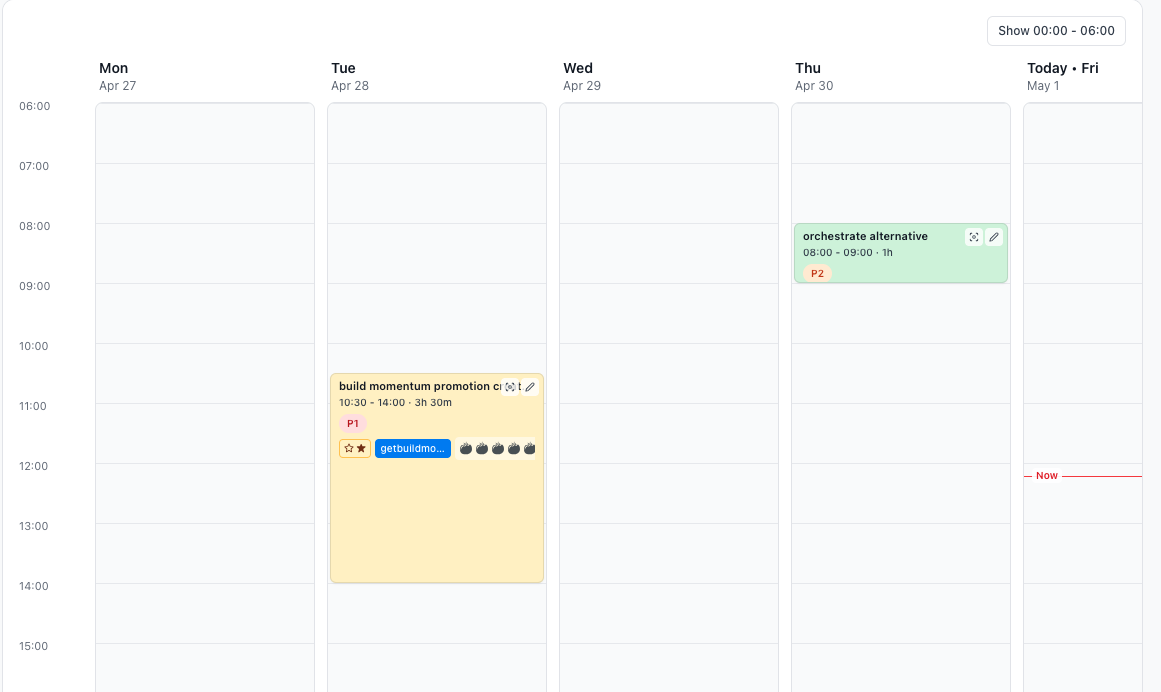
A task without context is just a word on a list. You capture it, feel briefly organised, and then open the list on Monday morning to find fifty items with no indication of what matters, what’s time-sensitive, what belongs to which project, or what you were actually thinking when you wrote it.
The other failure mode is the opposite: a system so complex you spend your evenings maintaining it instead of resting. Five apps, three integrations, one export that broke last Tuesday.
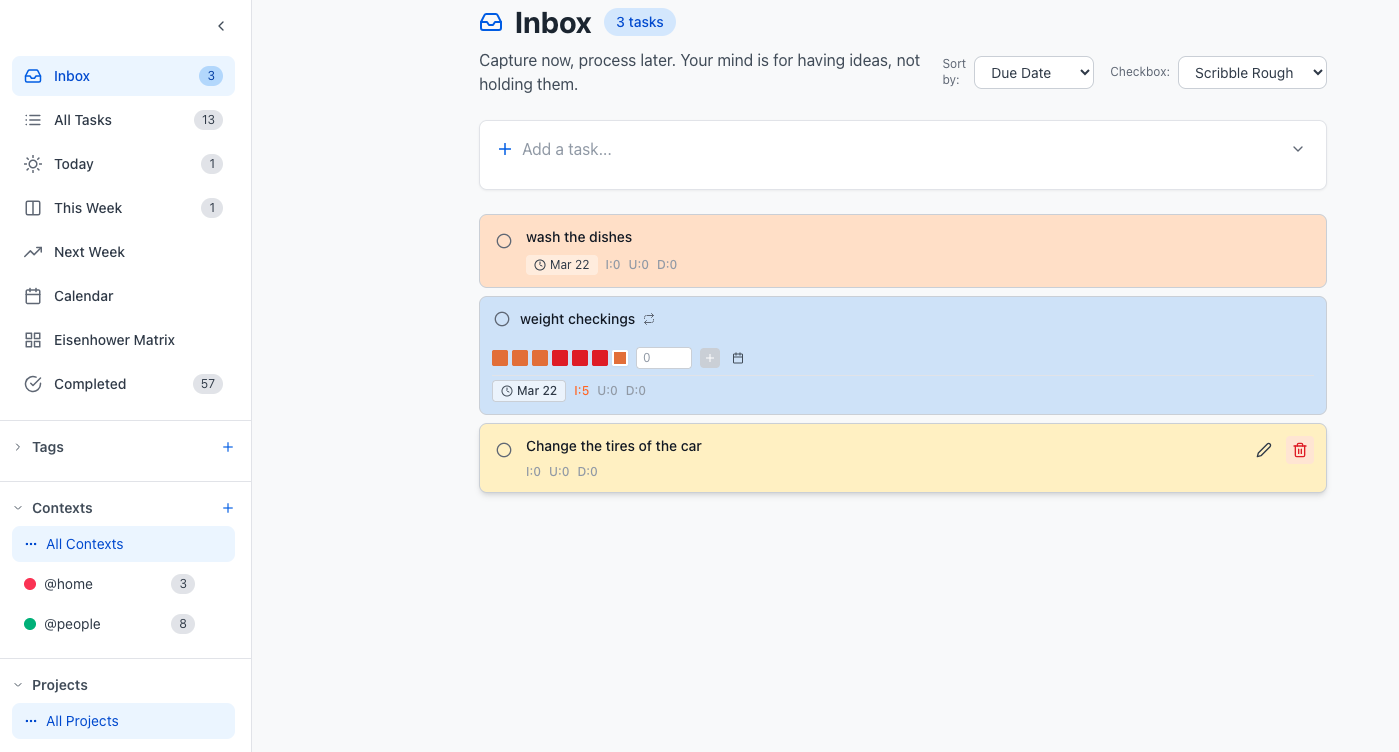
The GTD inbox exists for one reason: to separate capture from clarification. When an idea or commitment lands in your head, the last thing you need is to decide where it goes before you’ve even finished thinking it.
Dump it. Decide later. Nothing disappears into a forgotten list — the inbox count stays visible until you clear it.
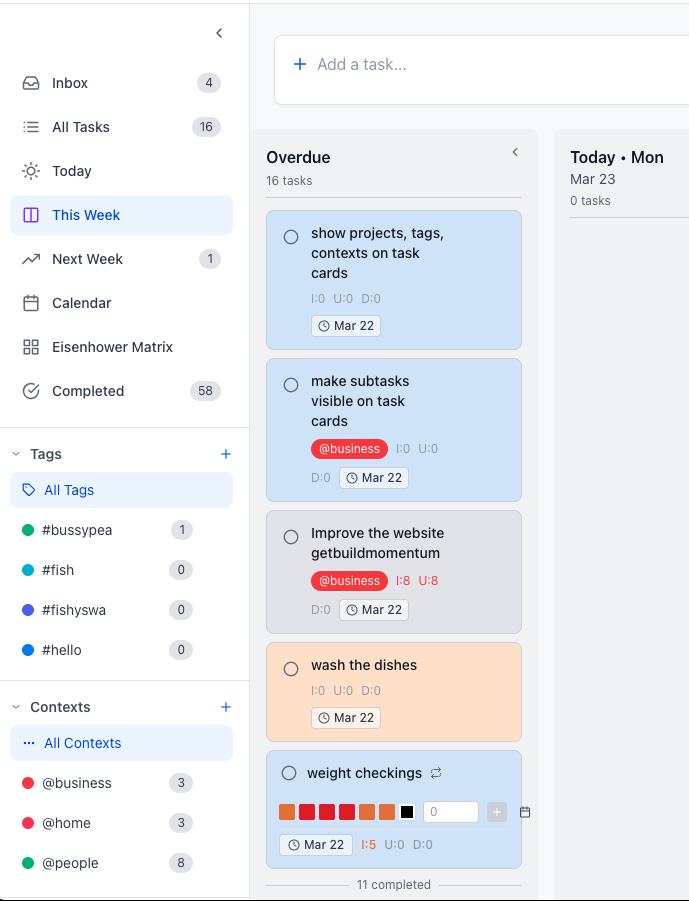
Different moments in your week require different lenses on the same work. Build Momentum gives you all of them, powered by the same underlying task record.
List view
See your tasks in a familiar to-do list view.
Kanban board
See your tasks in a familiar kanban board view.
Time blocks
A calendar and time view where you can add your tasks to specific days and times and easily drag and drop tasks to other days and times.
Timeline
For work that spans days — but that isn’t big enough to deserve its own project. Set a start and end date and the task renders as a bar across days, so the days you are committed to that task are easily visible and distinguishable.
Calendar
Month or agenda views that pull in tasks with due dates. It gives you a bird’s eye view of upcoming tasks in the current and future months.
Eisenhower Matrix
Four quadrants so loud-but-unimportant work stops stealing deep-work oxygen. Pulled from the same urgency and importance fields as the rest of the system.
Reminders
Set a deliberate reminder for every task manually. Choose when you want to be notified — 1 hour before, 15 minutes before, or right when the task starts.
! tokens inline to set every detail without touching the mouse.Familiar to Todoist and TickTick power users — with more depth.
Buy milk !due:15.4. !st9:00 !ee:25 !pr:Home !i4 !hl!due:15.4.2026 — due date!st9:00 !et10:00 — scheduled start and end time!sd:1.1. !ed:2.1.26 — multi-day span for Timeline!ee:25 !ae:20 — estimated and actual effort in minutes!pr:Work — assign to a project@phone #errand — context and tag!i4 !u2 !d1 !p2 — importance, urgency, difficulty, priority!c:pink or !c#D6E5FA — color by name or hex!hl — highlight, pins to top of dashboardOne line. Zero clicks. Everything set.
Hit the ? button in the title field any time for the full token reference.
@home, @calls, @computer. Filter across every view.#waiting, #deepwork, #client.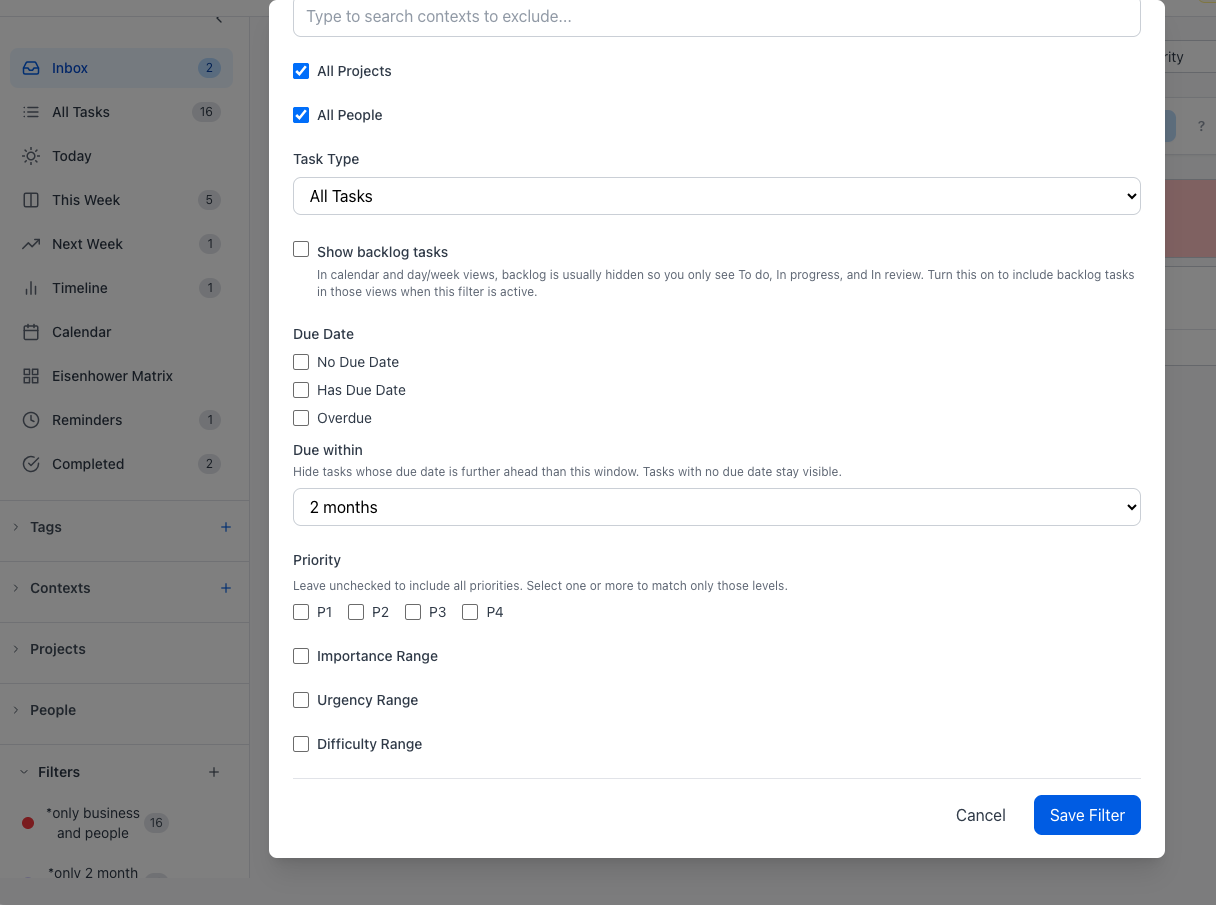
Contexts answer: where or with what am I doing this?
@phone, @computer, @errands, @home — batch by tool, energy, or location so you’re not context-switching between a call and a deep work session because your list didn’t know the difference.
Tags answer: what theme does this belong to?
#waiting, #deepwork, #tax, #client — cross-cutting themes that run across projects. Stack tags with contexts for surgical filtering.
Saved filters answer: how do I get back to this exact slice in one click?
Combine context, tag, project, due window, highlight, and goal-linked criteria into a reusable filter. “This week + @calls”. “Deep work + not scheduled”. “Client X + high importance”. One click on review day. No rebuilding the mental model from scratch.
When it’s time to execute — not plan, not triage, not organize — Focus Mode gives you a single task overlay that removes everything else from view. The work you chose is the only thing on screen.
Use it for deep work blocks, timed sessions, or any moment when the list needs to disappear so the work can happen.
Up to 50 tasks, core list and kanban workflows, due dates
Up to 2,000 active tasks, advanced filtering, saved filters, improved review workflows
Unlimited active tasks, maximum workflow flexibility
Active means incomplete. Complete or delete tasks to free up slots on any plan. Your completed history is always preserved.
The differentiator isn’t raw task count. It’s what tasks connect to.
Strong task surface with a decent habits layer. But habits and strategy stay shallow unless you duct-tape more apps together. No unified project KPIs, no integrity coin system, no contracts — execution and accountability still live in separate tools.
Excellent capture and a clean interface. Goals and deeper accountability live somewhere else. Karma gamifies volume more than the integrity of the commitments you actually care about. Budget, relationships, and project narrative still fragmented.
Tasks beside habits, projects, notes, and people — one login. Full GTD views plus Eisenhower plus power typing. Integrity Coins and contracts align stakes with the outcomes you chose. The list isn’t a graveyard. It’s connected to everything that matters.
What’s the difference between Inbox and All Tasks?
Inbox shows incomplete tasks with no context assigned — it’s the pure capture lane for things that still need a decision. All Tasks shows everything active regardless of context assignment.
What happens to tasks in the backlog?
Backlog tasks are hidden from most date-focused views by default. You can surface them using a saved filter that includes backlog — useful for weekly “someday/maybe” reviews.
Is the syntax the same as Todoist or TickTick?
Similar idea, more attributes exposed. The ! token system covers everything from dates and times to importance, urgency, difficulty, color, and highlight. Hit the ? button in the quick add title field for the full reference.
Can I use Tasks without the rest of Build Momentum?
Yes. Start with Tasks alone. Add Goals & Habits, Projects, or Notes when your work outgrows a list.
What counts as an “active” task for plan limits?
Any incomplete task. Completing or deleting tasks frees up slots. Your completed history is always preserved regardless of plan.
Start free — no credit card required.
